The 2026 guest service technology landscape for hotels — virtual concierges, AI chatbots, voice assistants, in-room tech, and how operators sequence adoption.
Disclaimer: The insights and discussions presented in this blog series are intended to provide a broad overview of modern hotel technology stacks. The content is designed for informational purposes and may not reflect the most recent market developments. Every hotel's needs and circumstances are unique; thus, the technology solutions and strategies discussed should be tailored to meet specific operational requirements. Readers are advised to conduct further research or consult with industry experts before making any significant technological investments or strategic decisions.
Guest service technologies, things like online concierges, are the digital tools a hotel uses to make a stay easier for the person paying for the room. The category is broad. Mobile apps that let a guest sort out their booking from the airport, web chat that runs on WhatsApp, in-room tablets controlling the AC, kiosk check-in for the 11pm late arrivals — they all sit under the same heading. The point is the same in every case: less friction between the guest and what they want next.
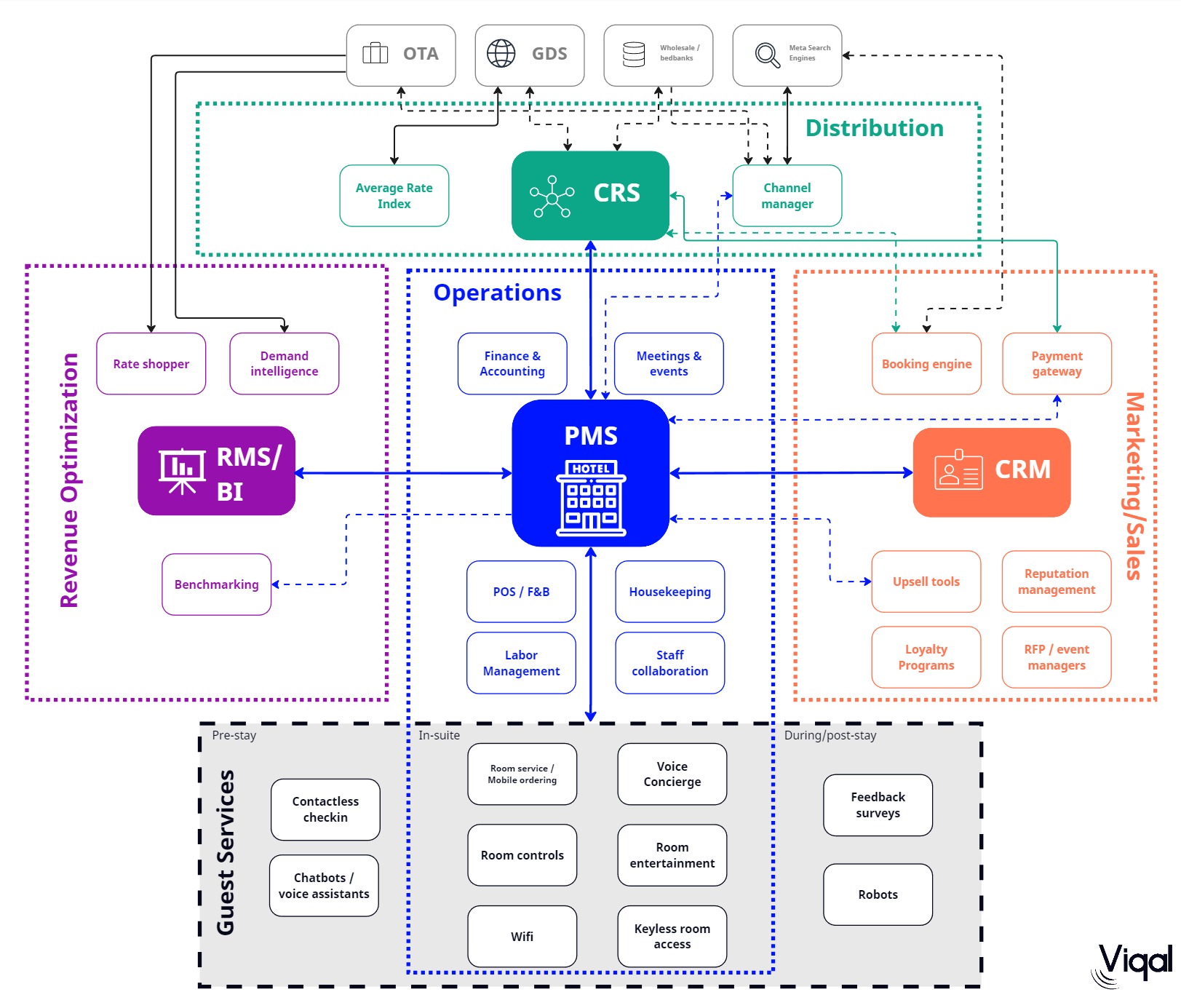
Mobile is no longer a feature in hospitality. It is the default channel. A booking that starts on a phone now finishes there too: pre-arrival upsell, room selection, mobile key on Salto or Assa Abloy hardware, late checkout request via SMS. (Honestly, the front desk queue at 3pm is the clearest signal that something in the mobile stack is broken.) Guests who never want to talk to a person can avoid one entirely. Guests who do still get a human. Both groups end up happier, and front office payroll usually drops two to four hours a day.
AI, data analytics and IoT have pushed personalisation past the basics. The room remembers the temperature the guest set last visit. The CRM knows the partner's name. The chatbot knows the dog is coming. Smart thermostats, voice assistants in selected suites, and a unified guest profile pulled from the PMS make this work in practice — though it only works if the data is actually clean. Most properties we see have three or four duplicate profiles per repeat guest. That is the real blocker, not the tech.
Kiosks earn their floor space when arrival volume is concentrated and predictable. Airport hotels, big city limited-service brands, anywhere with a 4pm wave of business travellers. They sync directly with the PMS so a key is cut and a folio is open without any front-desk intervention. The flip side: kiosks are not a fit for every property. A 24-room boutique with a single check-in agent gains very little from a £6,000 box that mostly sits idle. Buy them where the queue actually exists.
A virtual concierge is the layer between a guest's question and a member of staff doing something about it. Think of it as the front desk's first filter. The good ones plug straight into the PMS, the CRS and the CRM, so when a guest asks for a late checkout the system already knows whether the room is sold the next night. The very good ones add analytics on top: response time, deflection rate, where staff are spending their hours. Categories of inquiry these tools handle:
A virtual concierge only works when it is genuinely connected to the operations stack — PMS, housekeeping, F&B POS, maintenance dispatch. Without those pipes it becomes a fancy FAQ widget that staff ignore by week three. With them, the request a guest types at 11.47pm becomes a task in the housekeeping board at 11.48pm, with the right priority and the right room number. Where it helps:
Rolling out advanced guest service technology is not free. There is the upfront cost, the training time, the headache of getting two systems to talk to each other when one of them was built in 2008. (Anyone who has integrated an old Opera install with a modern messaging platform knows what we mean.) But on the other side: shorter response times, higher review scores, and a market position that lets a property charge slightly more because the experience is slightly better.
What is coming next? More AI in the conversation layer, augmented reality wayfinding for big resorts, a deeper IoT footprint in the room. Blockchain gets mentioned a lot in vendor decks; we are sceptical it shows up materially in front-of-house operations any time soon. The bet we would make is on unified guest profiles — the system that finally collapses PMS history, CRM segments and inbound messaging into one operator view.
Guest service tech, when it works, is invisible. The guest types a question, gets an answer, and goes back to their evening. The hotel sees a clean task list, accurate data and staff who are no longer drowning in repetition. The gap between properties that have built this layer and ones that have not is widening fast.
← Previous: Part 6: Revenue Management Systems (RMS) and Dynamic Pricing | Next: Part 8: In-Room Technology →
.avif)
Guest service technologies are the digital tools that make a stay easier: mobile apps for booking management, online platforms, and in-room tablets. They take friction out of the parts of a stay where a guest used to need a staff member, and free staff up for the parts where a person genuinely helps.
Viqal automates the guest inquiry process end-to-end, from natural conversation to PMS data entry, without manual staff effort. Deep hotel tech experience means it slots into existing systems rather than fighting them, so guest interactions stay efficient and staff roles get more strategic.
Mobile apps let guests handle bookings, access services and reach staff from their phone. Contactless check-in and digital keys give a touch-free arrival that matches what most travellers now expect: speed, no queue, and as little physical handover as possible.
Match the technology to operational pain — high message volume needs an AI Operator; high amenity volume needs an in-room tablet; high housekeeping coordination needs a maintenance and dispatch system. Don't buy technology for completeness; buy it for the specific workflow it removes from staff hands.
Predictive guest preference engines (using stay history to anticipate requests), voice assistants for accessibility, real-time multilingual messaging, augmented reality wayfinding for large resorts, and unified guest profile platforms that consolidate PMS, CRM and messaging history into one operator view.
Track first-response time, deflection rate (questions resolved without staff), ancillary revenue per stay, review score floor (lowest quartile improvement), and staff hours reallocated to guest interaction. Together these five metrics give a fuller ROI view than any single number does.
.avif)