What hotel voice assistants actually do in 2026: in-room use cases, PMS integration patterns, privacy concerns, vendor landscape, and why most hotels still hold off.
A hotel voice assistant is a hands-free guest interface, typically an in-room smart speaker (Amazon Alexa for Hospitality, Google Nest, or hospitality-specific devices) that responds to spoken requests for room control, service requests, and information. In 2026, voice in hotels is a real but narrow category: useful where deployed well, often skipped where the operational case is thin.
This article covers where voice assistants fit in the hotel tech stack, the use cases that actually work, the privacy and security questions that often kill deployments, the vendor landscape, why most hotels still don't deploy at scale, and the realistic outlook. (My honest read after watching a dozen-odd EU pilots: the hardware is the easy part.)
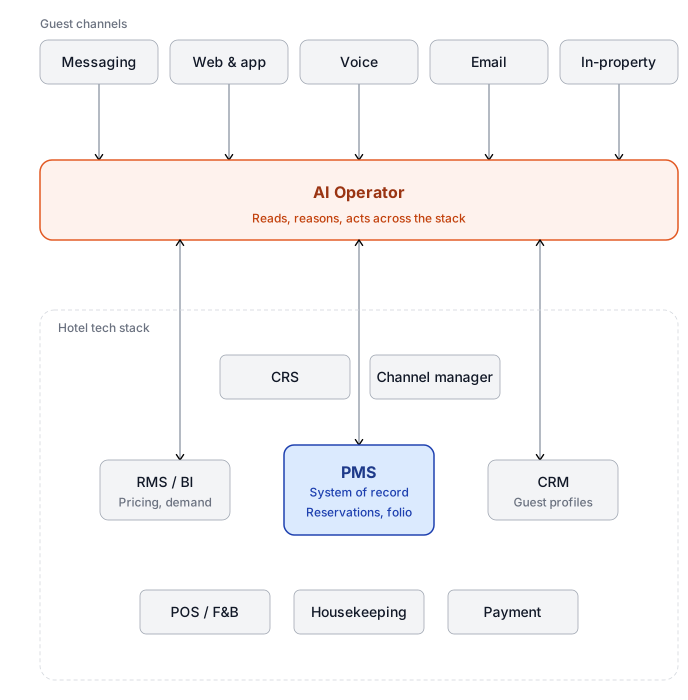
A hotel voice assistant typically sits in the in-room device layer, alongside the TV, in-room tablet, and smart thermostat. To be operationally useful it needs three integrations:
Without these connections, voice becomes a novelty: it can play music and tell jokes but can't do anything operationally useful. See integrations and APIs in the hotel tech stack.
Three categories where voice assistants earn their keep.
Lights, climate, blinds, TV, do-not-disturb. The most reliable use case: fast, hands-free, high-frequency. Guests genuinely enjoy it when the integration with room hardware is clean. It's particularly valuable for guests with mobility constraints, where voice control becomes an accessibility feature rather than a convenience.
"Bring extra towels." "What time does the spa open?" "Order breakfast for 8 AM." These work when the request feeds into the same operational workflow staff already use. They fail when voice creates a parallel ticket queue no one watches.
Hotel hours, restaurant menus, local recommendations. Useful, but only if the property keeps the knowledge base current. A voice assistant confidently quoting last year's restaurant hours creates more friction than it removes.
Voice in hotels carries privacy considerations that don't apply to chat.
Even with wake-word activation, an always-on microphone in a guest room is a category guests have legitimate concerns about. Vendors mitigate with hardware mute, clear privacy modes, and explicit guest consent. The perception barrier is still real, especially in markets with strong privacy expectations (Germany, the Nordics, parts of APAC).
Voice transcripts contain sensitive guest content. Where they're processed (cloud region), how long they're retained, who has access, and whether they're used for vendor model training all need explicit answers in the contract. EU operators in particular need EU-resident processing and retention controls. See data security and compliance and GDPR compliance in hotels.
Multi-guest rooms and family rooms raise additional questions about whose voice is recognised and whose preferences apply. Most current systems handle this clumsily.
If the voice assistant can trigger PMS actions (late checkout, room move, billing), spoken-only authentication is weak. Most production deployments require staff confirmation for any action with financial or security implications.
Three categories of voice deployment in hotels in 2026:
| Category | Examples | Strengths | Weaknesses |
|---|---|---|---|
| Hospitality-skinned consumer devices | Alexa for Hospitality, Google Nest hospitality builds | Familiar UX for guests, broad skill ecosystem | Privacy perception, ongoing vendor commitment uncertain |
| Hospitality-native voice platforms | Volara, Angie, others | PMS-aware, privacy-tuned, hospitality workflows | Smaller ecosystems, narrower device support |
| Voice on existing in-room tablet | Various tablet vendors with voice modules | One device for everything, easier privacy story | Not always-on; requires guest interaction first |
The right choice depends on segment, market, and existing tech stack. Luxury and resort segments lean hospitality-native. Midscale often runs hospitality-skinned consumer devices. Budget and hostels usually skip voice entirely.
Despite a decade of voice in hotels, most properties still don't deploy. Five recurring reasons:
For most independents and group properties, an AI Operator on WhatsApp and web chat covers more of the guest journey at lower cost and with cleaner privacy posture than in-room voice. Voice is additive once the messaging layer is solid, not a substitute for it.
Three trends shape the next phase.
So when does it make sense? Deploy voice when (1) you're already doing a room-tech refresh, (2) your guest segment values it (resorts, accessibility-forward properties), (3) you have the integration appetite and budget, and (4) your messaging-channel coverage is already strong. Skip it when any of those is missing.
Voice assistants in hotels are real and useful in 2026, but they complement messaging rather than replace it, and the deployment economics demand an honest look at integration depth, privacy posture, and segment fit. Most properties still get more operational mileage from a strong messaging stack on WhatsApp and web than from in-room voice. Where voice fits, it fits best as part of a planned room-tech refresh with full PMS and workflow integration.
Want to lock down the messaging-layer fundamentals first? See the AI Operator overview or run the numbers with the ROI calculator.
.avif)
A hotel voice assistant is a hands-free guest interface, typically an in-room smart speaker (Amazon Alexa for Hospitality, Google Nest, hospitality-specific devices) that responds to spoken requests for room control, service requests, and information. To be operationally useful it needs to integrate with the PMS, room-control hardware, and the same workflow systems staff use for chat-based requests.
The reliable use cases: room control (lights, climate, blinds, do-not-disturb), in-room ordering and service requests (extra towels, F&B, late checkout), and information requests (hotel hours, menus, local recommendations). They fail when integrations are thin. A voice assistant without PMS or workflow integration becomes a novelty, not an operational tool.
They carry real privacy considerations: always-on microphones in private guest space, voice transcript data residency and retention, multi-guest privacy in family rooms, and weak spoken-only authentication for sensitive actions. Vendors mitigate with hardware mute, privacy modes, and explicit consent, but the perception barrier is significant, especially in EU markets with strong privacy expectations.
Deploy when four conditions hold: a room-tech refresh is already planned, your guest segment values it (resorts, accessibility-forward properties), you have integration budget for PMS and workflow connections, and your messaging-channel coverage is already strong. Skip when any of those is missing. Most properties get more operational mileage from a strong WhatsApp and web messaging stack first.
Five recurring reasons: privacy perception barrier with always-on microphones, hardware refresh cost without an existing room-tech program, integration depth required for PMS and workflow connections, narrow operational ROI versus messaging channels that cover the whole stay, and ongoing maintenance overhead for knowledge bases and devices. Voice is additive, not a substitute for messaging.
Different jobs. Voice excels at hands-free in-room moments: turning on the lights, adjusting climate, requesting towels at 11 PM. Messaging (WhatsApp, web chat, email) covers the entire guest journey including pre-arrival and post-stay, runs at lower per-room cost, and has a cleaner privacy posture. Most hotels get higher ROI from a strong messaging stack first, with voice added later for specific in-room scenarios.
.avif)