Navigating the World of Concierge Bots in the Age of Artificial Intelligence
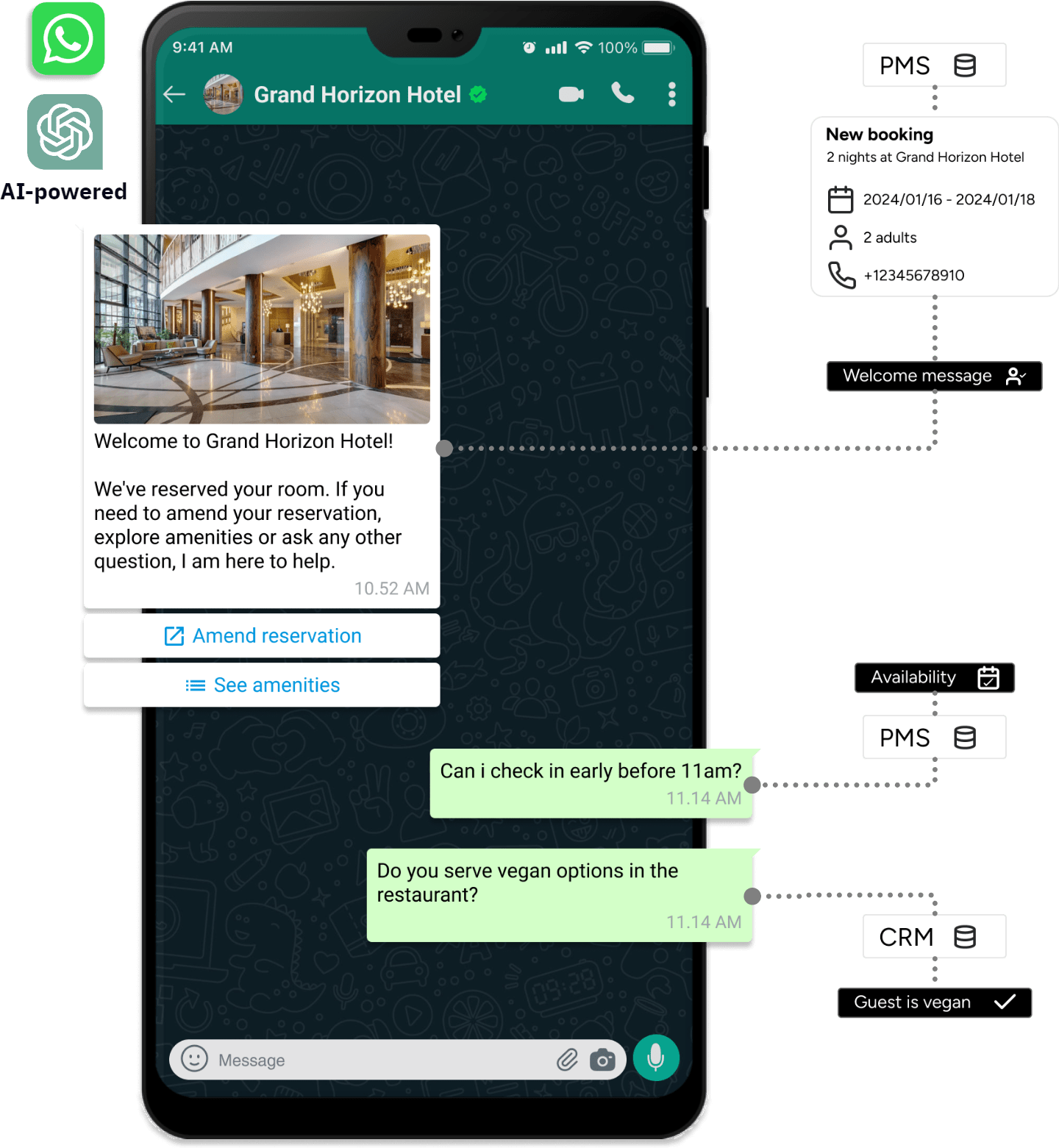
Chatbots have woven themselves as indispensable threads. The journey began with simple automated programs in customer service, evolving into sophisticated entities capable of mimicking human-like interactions. This transformation was fueled by advancements in technology, particularly in the realms of artificial intelligence (AI) and machine learning. Today, concierge bots are not just tools for automation; with LLM technology like ChatGPT for hotels they have become integral in enhancing user experience, streamlining business processes, and forging a new path in human-computer interaction.
Imagine a chatbot as a digital librarian, methodically organizing and responding to inquiries based on a set script. This is the essence of rule-based chatbots. They operate using a defined set of rules and algorithms, responding to user inputs that match specific triggers or keywords. Picture a flowchart where each user input leads down a predetermined path, culminating in a response that aligns with the rules set by its creators.
These chatbots are programmed to handle a range of expected scenarios. For instance, if a customer asks about store hours, the chatbot responds with the pre-loaded information. However, if the question deviates from the script, the chatbot might not be able to comprehend or respond accurately.
In the realm of e-commerce, rule-based chatbots are akin to efficient sales clerks. They guide customers through product catalogs, answer FAQs about shipping and return policies, and assist in tracking orders. They provide instant responses, enhancing customer experience by offering quick, straightforward solutions.
In the banking sector, these chatbots are often deployed for tasks like account balance inquiries, transaction histories, and simple banking queries. They ensure security by following strict protocols and provide users with reliable, immediate assistance for routine banking needs.
The strengths of rule-based chatbots lie in their consistency and reliability. They are excellent for tasks where responses can be predicted and standardized. For businesses, they offer a cost-effective solution to handle high volumes of routine inquiries without the need for human intervention.
However, the limitations of rule-based chatbots become apparent in scenarios requiring a deeper understanding of language nuances or complex problem-solving. They lack the ability to learn or adapt beyond their programming, making them less suitable for situations where user inputs are unpredictable or varied. Their inability to handle ambiguity or elaborate customer needs can sometimes lead to frustrating user experiences, especially when users expect a level of understanding similar to human interaction.
AI-based chatbots are akin to digital chameleons, seamlessly adapting and evolving with every interaction. These chatbots leverage artificial intelligence (AI) and machine learning (ML) to go beyond pre-programmed responses. At their core, they utilize natural language processing (NLP), a branch of AI that enables them to comprehend, interpret, and respond to human language in a way that's strikingly similar to human conversation.
The magic of these chatbots lies in their ability to learn from data. They analyze patterns in language and user behavior, continuously improving their ability to understand and respond to complex queries. This learning process allows AI chatbots to become more intelligent and efficient over time, offering personalized and contextually relevant responses.
The primary distinction between AI-based and rule-based chatbots is their ability to handle unstructured queries. While rule-based chatbots thrive on clear, specific commands, AI chatbots can navigate the nuances of human language. They understand slang, idioms, and even detect sentiment, which enables them to engage in more natural, fluid conversations.
AI chatbots are not confined to a fixed set of rules. They can interpret a wide range of inputs, including those that don't fit into predefined categories. This flexibility makes them particularly valuable in scenarios where user inputs are diverse and unpredictable.
AI chatbots have found their place in a multitude of applications, revolutionizing the way businesses interact with their customers. In the world of smartphones, virtual assistants like Siri and Google Assistant use AI to help users with everything from setting reminders to answering complex queries. In healthcare, AI chatbots offer mental health support, providing users with therapeutic conversations and coping mechanisms. In customer service, they handle a broader range of inquiries, offering solutions based on past interactions and user preferences.
The adaptability of AI chatbots is their most significant advantage. They provide a level of personalization and understanding that mimics human interaction, enhancing user experience significantly. For businesses, this means better customer engagement, higher satisfaction rates, and a wealth of data to further refine services and products.
However, with great power comes great responsibility. AI chatbots face challenges in terms of data privacy and ethical considerations. The vast amount of data they handle requires stringent security measures to protect user information. Moreover, the complexity of continuous learning and the need for large, diverse data sets for training can be resource-intensive. There's also the challenge of ensuring that the AI doesn't develop biases based on the data it's fed, maintaining fairness and neutrality in its responses.
When comparing rule-based and AI-based chatbots, it's like contrasting a reliable classic car with a modern, high-tech vehicle. Both have their distinct places and serve different purposes.
When choosing between rule-based and AI-based chatbots, businesses need to consider several factors:
The decision between rule-based and AI-based chatbots hinges on a balance of practicality, budget, desired customer experience, and long-term business goals. Each type has its unique set of strengths and challenges, making them suitable for different business scenarios.
The trajectory of chatbot technology is pointing towards an increasingly sophisticated and integrated future. We're entering an era where the line between human and machine communication is becoming blurred, thanks to the advancements in AI.
AI is the driving force behind the evolution of chatbots, and its impact is set to become more profound.
The future of chatbot technology, underpinned by advanced AI, promises more empathetic, integrated, and proactive virtual assistants. As they become more ingrained in our daily lives, chatbots are set to redefine the way we interact with technology, making it more intuitive, personalized, and human-like.
Chatbots, evolving from simple rule-based systems to advanced AI-driven models, have significantly changed our interaction with digital systems. Rule-based chatbots offer reliability for structured tasks, while AI chatbots excel in managing unstructured conversations and personalizing responses. This evolution enables businesses to choose based on their specific interaction needs and digital strategies. Looking forward, AI-enhanced chatbots promise more human-like, proactive interactions, increasingly blending into our daily lives and various industries like customer service and healthcare. As we adopt these technologies, it's vital to balance their benefits with the human aspect of their use.
.avif)
Viqal stands out by fully automating the guest inquiry process for Stayntouch, from initiating natural conversations to data entry in Stayntouch, all without manual effort from staff. Our deep hotel tech stack know-how ensures seamless system integration, making guest interactions efficient and staff roles more strategic.
The main difference lies in their method of interaction and learning capabilities. Rule-based chatbots follow predefined rules and scripts, making them suitable for straightforward tasks. They respond to specific commands or keywords but lack the ability to learn from interactions or handle complex, nuanced queries. On the other hand, AI-based chatbots use artificial intelligence and machine learning to understand and respond to a wide range of queries. They can handle unstructured conversations
While AI-based chatbots are becoming increasingly sophisticated, they are not likely to completely replace human customer service representatives in the near future. Chatbots excel in handling routine queries and providing instant responses, but they may still struggle with extremely complex issues or highly emotional situations where human empathy and nuanced understanding are crucial. The ideal scenario is a collaborative one, where chatbots handle the bulk of standard inquiries, thereby freei
.avif)